The Soul

He steps with a splash into the puddle. Unlike its kin, this puddle is perennial, fed by the mist of a waterfall that never sleeps. He turns, breathes in the cold humid air, and sees her. She smiles and a thousand butterflies jump from the walls of his heart. He’s enamored. Taken hostage by her laugh. She urges him to “look up” at the natural beauty surrounding them. He pauses and soaks it in. A moment later, they move together as the trail winds through a moss-laden forest. An hour passes. Clouds argue with the sun over what color to paint the earth, and occasional beams of golden light bounce off the trees above. He raises his gaze to meet the horizon, feeling full. Light.

This is one of many examples of what makes us truly human. To experience the natural world. Each other. The reality of allowing our senses to take in our surroundings. Knowing nothing and no one can take it away from us.

Let’s face it. Technology is exploding. And those who control it will continue to strive for our attention. Now, more than ever, we must hold on to what truly matters. Real connection.

Let this push you this week, this month, and this year, to find ways that allow you to be human. Write that letter to your friend. Mess up a word or two on an email without Grammarly AI or prompts. And find ways with me to continue nurturing the thing that this impending intelligence can never take away. Our ability to connect, feel, believe, and love.

Secrets of a Successful Career, by Heather Merrill (Guest Post)

My mother’s wonderful and insightful post about what’s made her career successful. After 20 years of taking care of three little minions (us) full-time, she went back into the workforce and has been on the job for the past 15 years. It’s been amazing to see her overcome challenges and thrive in a demanding career. Here are some of her reflections:

Warning: These are not popular on LinkedIn

Having accumulated a few years of work experience, I’m now reflecting on what leads to a successful career. It’s not always the formulas you read about on LinkedIn. Is a successful career staying at the same company for years, even though you should quit to thrive? Is it never getting fired, laid off or treated unfairly? Is it not having to prove yourself over and over? Is it all about remote work? Does success mean you don’t have to apply for countless jobs or endure rejection? I don’t think so. It’s how you navigate through those inevitable struggles that builds a rewarding and successful career.

Here are eight qualities that can lead to success:

1. Gratefulness: Cultivate gratefulness by getting involved in the lives of others less fortunate than you. Have you spent significant time with anyone who can’t afford an education or who comes from a background with unspeakable hardship? Find a way to rub shoulders with them, whether it’s volunteering for an inner-city non-profit or traveling to another country. A wider perspective cultivates gratefulness.

2. Wisdom: I hear people say they don’t want anyone to tell them what to do, that we should believe in ourselves and forge our own path. They say things like, “I’ll learn to be a parent on my own. Past ways of parenting are outdated.” Frankly, that kind of thinking is foolish. Hasn’t anyone before you learned something valuable? Why would we deny ourselves the treasured insight others have painfully gained? Wisdom is seeking out answers from those who’ve gone before us, and who learned the hard way. Grab every opportunity to gain wisdom.

3. Honesty: This quality has been diluted to the point where we think it doesn’t apply to things that make our lives harder. There are exceptions where we don’t really need to be honest, right? Should we really pretend we’re accomplishing a full-time remote job and yet spend most of our time on a side hustle? Honesty in the short-term can hurt. Yet, having a high level of integrity can take you a long way in your career. You’ll have peace of mind. Success will come to you. Dishonesty always catches up to you. I don’t think anyone gets off easy in the end.

4. Hard work: When each of my 3 kids was around six years old, I taught them to work by rewarding them with small change. They were overjoyed to get that quarter when they worked for me. I kept that motivation going by appropriately rewarding hard work. Later they started a lawn mowing business and worked other jobs during the school year. Pulling weeds and sweating in the hot sun wasn’t beneath them and didn’t make them crumble. Today, they’ve all finished college debt-free, and make their own living. There’s a proverb that says, “A little sleep, a little slumber, a little folding of the hands to rest and poverty will come upon you like a robber.” (In modern terms that could be gaming, scrolling, binging…) The downhill slide isn’t rare, I’ve seen it happen to people I know…

5. Relationships: No matter how skilled and successful we are, healthy relationships are essential to a healthy life. This means being able to give without requiring anything back. It means inviting people over even when you feel it’s one-sided. It means tuning into the needs of people around you and taking action instead of texting good thoughts. Pepper your day with acts of kindness. What a stress reliever and mood uplifter! You’ll also be surprised to find a great support network is there when you need it.

6. Balance: This is the secret ingredient to succeeding in most everything. Too much work, too much eating, too much alone time, too little exercise, too much talking and not enough listening. The list can go on and on. Evaluate where you can achieve more balance in your life. It might be easing your political dogma, adjusting your spending or even finding a new home for the dogs that wreck your family peace. Whatever it is, balance helps you persevere through the hardest of times. Prioritize what’s important and work towards balance. I’ve seen balance even save a marriage…

7. Purpose: Why do we work? If we don’t have an answer to that, it can lead to a lot of dissatisfaction in our jobs. Take some time out to reflect. Do you work so you can have certain luxuries? Or to give more away? Or because the job itself is intrinsically satisfying? Or because you’ve tied yourself down with debt? Or to better the lives of your family? Whatever it is, be sure your job serves a purpose that means something to your heart. With purpose, what might look menial or trivial on LinkedIn, can be fulfilling and rich to you. Don’t be driven by appearances, but by purpose.

8. Forgiveness: This is very misunderstood. Forgiveness by its own nature is unjust. It’s giving something to someone who doesn’t deserve it & may not have asked for it. Extending forgiveness hurts. So why is it important? Because holding un-forgiveness is personally harmful. It creates negativity, anger, bitterness and other unwanted baggage. Do you want to be a LinkedIn whiner? Longer term, do you want to have an ugliness about you? Forgive the person who fired you. Forgive the company layoff. Forgive the slights and the ghostings. Believe it or not, you’ll find yourself happier. When the next opportunity arises, you’ll be an appealing hire.

If you patiently pursue these qualities, no matter what happens this year, I’ll bet on your success!

You can find her original post HERE.

Tips for working from home well

Over the past several years, one of the notable impacts of the COVID-19 Pandemic is how it has changed our work lives. Pre-pandemic, only 7% of the workforce (with jobs that allowed for it) worked from home full-time1. A more recent report from the Bureau of Labor Statistics reveals this number has jumped to 22.8% as of last August2.

If you’re among many people who, like me, enjoy the 5-second commute from your home to your… home, here are a few ways I’ve learned to make the home office a more productive and enjoyable place.

  1. It’s so helpful to have my office space in a different room than my bedroom. I know some people can’t afford this luxury, but it truly helps to compartmentalize my work life and home life. It’s not quite a “Severance” of work and home life. But it does help to leave some of the difficulties of work in the office (room).
  2. Unless you really need it, keep your phone out of the office space. If you leave it in your kitchen or living room, you’ll be continually less likely to go check it. It tends to take the form of a little devil on my shoulder if it stays on the desk, personally.
  3. Take frequent breaks. Go for a 5-minute walk, do some jumping jacks, or crank out some push-ups in your yard. For me, this is a challenge (it’s easy to get sucked into the code, like Neo from the Matrix). But when I do pause, I find I’m a tad bit less cranky at the end of the day (my wife thinks so too). Plus, you can take that time to call friends/family or even, dare I say, write a blog post. If you want more stories on the benefits of taking frequent breaks during work, NPR’s TED Radio Hour has a great Podcast called “Body Electric”.

Welp, time to get back to the black box that is Python. Do you have any ideas on what has worked best for you working from home?

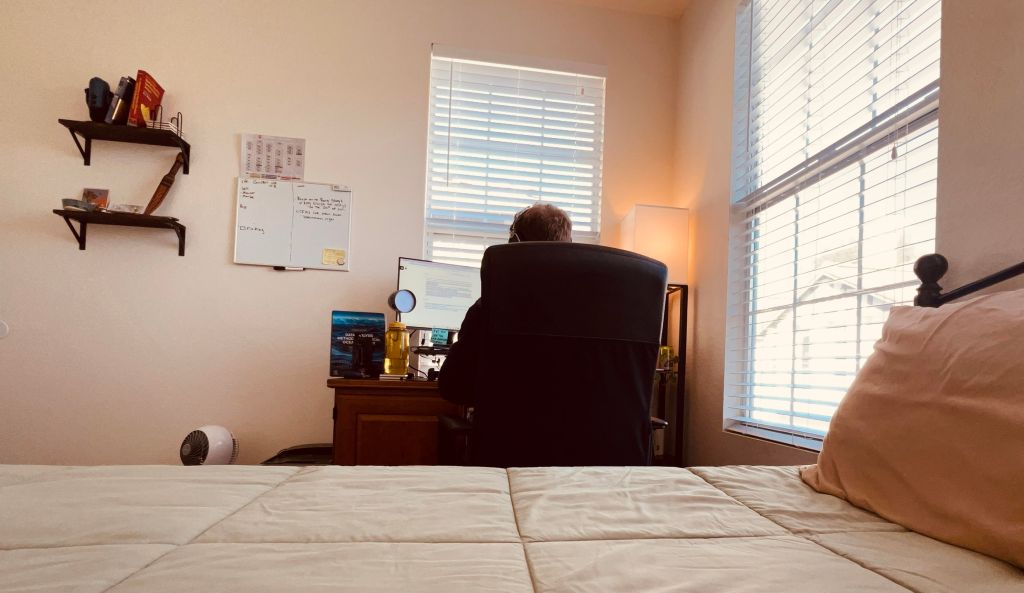
Working from our guest room today. If you zoom in you’ll see this post on the screen. Inception…

References

  1. https://www.pewresearch.org/short-reads/2023/03/30/about-a-third-of-us-workers-who-can-work-from-home-do-so-all-the-time/
  2. https://www.marketwatch.com/story/the-job-market-is-getting-tougher-for-workers-but-they-may-be-gaining-in-the-battle-over-remote-work-64fd9408

A (short) history of Brazilian jiu-jitsu and three benefits of trying it out

Ever thought about tackling someone in a friendly manner?

Brazilian jiu-jitsu (pronounced “joo-jitz-ooh” and usually shortened to BJJ) is a form of combat mainly composed of grappling between two individuals. Rounds start from sitting or standing positions and typically end on the ground with one individual “tapping out” or submitting to their opponent.

The first ever BJJ academy was founded in Brazil in 1925 by Carlos Gracie and his four brothers. That’s not even within the first several chapters of the sport’s story. Its roots stem from tactics needed on the feudal battlefield between Samurai warriors, whose heavy armor made striking in hand-to-hand combat exceedingly difficult. Realizing the effectiveness of chokes and joint manipulations in ground fighting, the first jiu-jitsu was officially taught to warriors in 1130 AD1.

Today, the art of BJJ continues to grow, with more than 44,000 studios open in the United States alone2.

If you’ve looked around while out and about and seen a little gym open in your neighborhood, have you considered opening the door? If you’re slightly daunted by the idea of “wrestling” or think of it as an aggressive sport, here are three surprising benefits of practicing.

  1. BJJ actually leads to lower levels of aggression in participants. A study found that people who engaged in the sport processed emotions more effectively3 and experienced practitioners reported lower levels of aggression compared to groups such as baseball players, hip-hop dancers, and even a general control group4.
  2. Feeling socially isolated? BJJ has been shown to provide social support that is quite effective in managing feelings of loneliness and social isolation, especially in participants who struggle with difficulties like PTSD5.
  3. Maybe you’re just into being more fit. Studies have shown that BJJ increases your flexibility, and a dominant body type in the sport is classified as mesomorphic, or a more muscular and robust build6.

Convinced yet? I’m not pushing (or tripping) you to try it, but you could make some new friends and get fit while doing it; just make sure to start out slow and be patient.

My sibs and I at my local gym.

References

  1. https://www.jiujitsubrotherhood.com/blogs/blog/the-history-of-brazilian-jiu-jitsu?srsltid=AfmBOopui0_aSYSClNBrL5w73O8FKo6JLjzJBYNxc0-FUiVRGyBktjeU
  2. https://www.ibisworld.com/united-states/industry/brazilian-jiu-jitsu-studios/6246/#TopQuestionsAnswered
  3. Wojdat, M., & Ossowski, R. (2019). Comparative analysis of the level’s aggression of women and men training Brazilian Jiu-Jitsu in the light of the possibilities for therapeutic purposes. Journal of Education, Health and Sport9(5), 319-338.
  4. Blomqvist Mickelsson, T. (2021). Brazilian jiu-jitsu as social and psychological therapy: a systematic review. Journal of Physical Education and Sport21(3), 1544-1552.
  5. Weinberger, K., & Burraston, T. (2022). Benefits of Brazilian Jiu-Jitsu in managing post-traumatic stress disorder: a longitudinal study. Journal of Community Engagement and Scholarship13(4).
  6. Andreato, L. V., Lara, F. J. D., Andrade, A., & Branco, B. H. M. (2017). Physical and physiological profiles of Brazilian jiu-jitsu athletes: a systematic review. Sports medicine-open3, 1-17.

Not feeling in the right mood? Listen to a funny podcast!

Let’s paint the scene. You’re driving to a party at a friend’s house for Christmas. Thinking back on the day, you sigh. You couldn’t finish that dumb report technically due at the end of the day and stubbed your toe on the little bump in the entrance to your apartment this morning. Your toe still hurts.

To lighten the mood, you turn on a podcast from one of your favorite comedians, and pretty soon small huffs turn into chuckling. Before you know it, you’re all out laughing when you pull up to the party.

My friends laughing at the joke I told the other day. Kidding I have no idea who these people are. Photo by Jed Villejo on Unsplash.

Humor is a great way to cope with life’s stresses. In the book, The role of humor and the self1, people who respond to stressors humorously are “more likely to emerge from emotional duress and enjoy a restoration of positive mood states”. Other researchers found that study participants who recalled humorous times in their past had a higher pain tolerance threshold and a decrease in hormones associated with stress2. Ziv (1976)3 also saw adolescents who openly laughed at humorous stimuli scored higher on a creativity test than those who didn’t. Laughing will allow your mind to relax and explore those more “out there” thoughts which can lead to deeper and more engaging discussion with those around you.

Next time you’re in the car tapping anxiously on the steering wheel, pop on a podcast or remind yourself of the funny times in your past. You might just create another memory you can look back on and laugh.

  1. Lefcourt, H. M., & Davidson-Katz, K. (1991). The role of humor and the self. Handbook of social and clinical psychology: The health perspective, 41-56.
  2. Greenberg, M. J. (2024). Self-Guided Humorous Imagery Mitigates Pain and Anxiety: A Repeated Measures Pilot Study. Journal of Holistic Nursing42(2), 121-132.
  3. Ziv, A. (1976). Facilitating effects of humor on creativity. Journal of educational psychology68(3), 318.

Blog at WordPress.com.

Up ↑