A (short) history of Brazilian jiu-jitsu and three benefits of trying it out

Ever thought about tackling someone in a friendly manner?

Brazilian jiu-jitsu (pronounced “joo-jitz-ooh” and usually shortened to BJJ) is a form of combat mainly composed of grappling between two individuals. Rounds start from sitting or standing positions and typically end on the ground with one individual “tapping out” or submitting to their opponent.

The first ever BJJ academy was founded in Brazil in 1925 by Carlos Gracie and his four brothers. That’s not even within the first several chapters of the sport’s story. Its roots stem from tactics needed on the feudal battlefield between Samurai warriors, whose heavy armor made striking in hand-to-hand combat exceedingly difficult. Realizing the effectiveness of chokes and joint manipulations in ground fighting, the first jiu-jitsu was officially taught to warriors in 1130 AD1.

Today, the art of BJJ continues to grow, with more than 44,000 studios open in the United States alone2.

If you’ve looked around while out and about and seen a little gym open in your neighborhood, have you considered opening the door? If you’re slightly daunted by the idea of “wrestling” or think of it as an aggressive sport, here are three surprising benefits of practicing.

  1. BJJ actually leads to lower levels of aggression in participants. A study found that people who engaged in the sport processed emotions more effectively3 and experienced practitioners reported lower levels of aggression compared to groups such as baseball players, hip-hop dancers, and even a general control group4.
  2. Feeling socially isolated? BJJ has been shown to provide social support that is quite effective in managing feelings of loneliness and social isolation, especially in participants who struggle with difficulties like PTSD5.
  3. Maybe you’re just into being more fit. Studies have shown that BJJ increases your flexibility, and a dominant body type in the sport is classified as mesomorphic, or a more muscular and robust build6.

Convinced yet? I’m not pushing (or tripping) you to try it, but you could make some new friends and get fit while doing it; just make sure to start out slow and be patient.

My sibs and I at my local gym.

References

  1. https://www.jiujitsubrotherhood.com/blogs/blog/the-history-of-brazilian-jiu-jitsu?srsltid=AfmBOopui0_aSYSClNBrL5w73O8FKo6JLjzJBYNxc0-FUiVRGyBktjeU
  2. https://www.ibisworld.com/united-states/industry/brazilian-jiu-jitsu-studios/6246/#TopQuestionsAnswered
  3. Wojdat, M., & Ossowski, R. (2019). Comparative analysis of the level’s aggression of women and men training Brazilian Jiu-Jitsu in the light of the possibilities for therapeutic purposes. Journal of Education, Health and Sport9(5), 319-338.
  4. Blomqvist Mickelsson, T. (2021). Brazilian jiu-jitsu as social and psychological therapy: a systematic review. Journal of Physical Education and Sport21(3), 1544-1552.
  5. Weinberger, K., & Burraston, T. (2022). Benefits of Brazilian Jiu-Jitsu in managing post-traumatic stress disorder: a longitudinal study. Journal of Community Engagement and Scholarship13(4).
  6. Andreato, L. V., Lara, F. J. D., Andrade, A., & Branco, B. H. M. (2017). Physical and physiological profiles of Brazilian jiu-jitsu athletes: a systematic review. Sports medicine-open3, 1-17.

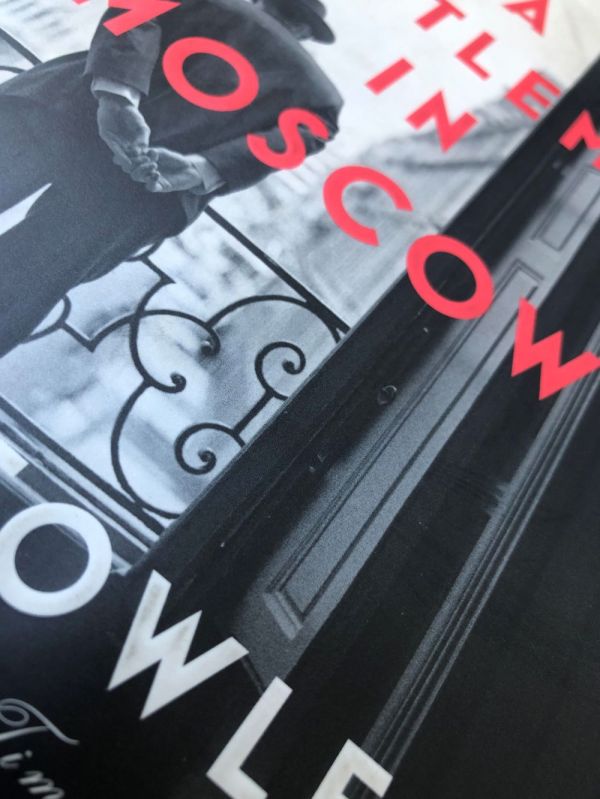
Review – A Gentleman in Moscow

They say the pen is mightier than the sword, yet Amor Towles has managed to master both. After each (rather small) progression through “A Gentleman in Moscow”, I am shocked at his ability to both capture my imagination and cut me to my core. 

This eloquent writing is not overly dense, as one would expect from the enigmatic pages of “Infinite Jest”, or more verbose works of C.S. Lewis, and tackling a chapter or two does not render the reader with a furrowed brow and finger buried in their mess of hair (or lack thereof). He can somehow string together phrases with more ease than a yellow-coated lobsterman can serve you the meat of that beloved red crustacean. 

So, without further ado, it is my delight to recommend you pick up any of the works of Amor Towles. I think you’ll find yourself grinning, let alone smiling, after each read.

Why we need the outdoors

You can feel the crunch of rock and dirt beneath your feet. The subtle whoosh of wind through trees as the sun bounces between nebulous clouds. You close your eyes and listen.

There’s something about the outdoors that seems to bring peace. And simply being out there is so good for you. Bratman et al., (2015) found that an experience outdoors in a natural environment compared to an urban environment had a greater impact on decreasing anxiety and increasing verbal cognitive memory. Another study indicates that time spent outside increases a child’s attention span and decreases stress, which, in lieu of COVID-19 and the shift to virtual learning, is very much needed (McCurdy et al., 2010). The spectrum of benefits is not restricted to the young alone, as research also shows that spending time in a garden slows cognitive decline and reduces falls in elderly patients with dementia (Whear et al., 2014).

So, I know you want to plop down on that comfy couch and throw on the Mandalorian, The Whitcher, The Last of Us, Stranger Things, Ted Lasso, Love is Blind, Arnol…. I could go on, but try going for a walk in the park instead. Your body and mind will give you a standing ovation in the long run.

(Can you guess where the photo was taken?)

  1. Bratman, G. N., Daily, G. C., Levy, B. J., & Gross, J. J. (2015). The benefits of nature experience: Improved affect and cognition. Landscape and Urban Planning138, 41-50.
  2. McCurdy, L. E., Winterbottom, K. E., Mehta, S. S., & Roberts, J. R. (2010). Using nature and outdoor activity to improve children’s health. Current problems in pediatric and adolescent health care40(5), 102-117.
  3. Whear, R., Coon, J. T., Bethel, A., Abbott, R., Stein, K., & Garside, R. (2014). What is the impact of using outdoor spaces such as gardens on the physical and mental well-being of those with dementia? A systematic review of quantitative and qualitative evidence. Journal of the American Medical Directors Association15(10), 697-705.

In a Pickle

Lately, I’ve grown rather tired of having to convey the hushed statement, “Yeah… I’ve never been to Florida before.” I recently moved to Baton Rouge, and now had no excuse to continue this lifelong streak, so my brother and I decided to take a four-day road trip to the panhandle in May, old school style.

No smartphones, no google maps, no social media. Just us, the open road, some CDs from the library (that we had to dust off), and a few books to keep us company.

The first destination? A glassy lake in Blackwater State Forest. To two sweat-drenched dudes forced to sit in a wheeled box of metal careening down the highway for hours, this was not a far cry from an oasis in the desert (the desert being the heat of the southern summer). The unpaved roads took us into the heart of a lush forest, but lack of elevation made navigation rather difficult, and it took quite a while to find our spot (several locals showed us the way).

After we parked our car at a pristine “primitive” campground furnished with a metal fire pit and two picnic tables, we quickly ran down to the lake and soaked our feet.

“What about a quick swim to the other side?” I asked Ben.

“So down.”

We popped our goggles on and began the 300m swim to the other side of the lake. Soon the shoreline behind us began to obscure, mimicking the weed-covered lakebed that receded into the murky depths out of sight.

I couldn’t help but wonder, what was down there? After all, we weren’t in Colorado anymore. I had heard stories of gators attacking people who encroached upon their territories, such as the infamous “Florida Man” who claimed he saw the inside of one’s mouth while fighting to stay alive (check out the story here).

I quickly steeled my nerves and continued to put one arm in front of the next for what seemed like an eternity. Finally, texture once again graced the bottom of the lake and I knew we were close to the other side.

Ben and I stood up once we saw the depth was no more than waist height and looked around. Locals at the far side of the lake must have been either in awe or simply laughing at two goggled, scared non-Floridians standing near the reeds, like some bewildered aliens on foreign soil.

As our eyes adjusted we noticed several black blotches contrasting the glistening water in the middle of the lake. They vanished several seconds later, only to pop up nearer than before. Thoughts ran through my mind of getting bit by a passing water moccasin (a deadly snake endemic to the south), losing a finger to a snapping turtle, or getting pulled under by the Florida version of the Loch Ness monster. To this day I have no idea what those creatures were.

We now had two options.

  1. Swim back and risk the above.
  2. Wade through the reeds and if we survive suffer through the long trek back around the lake to our campground half naked with no shoes.

We sighed, cried, high-fived, and chose option #1.

An eternity later and I was never so excited to see that olive green lake bed materialize from the depths. We clambered up onto the shore and swore never to swim in a swamp again.

I’m sure many of you have had encounters with the unknown before. It’s always a learning experience, isn’t it?

Exciting, thrilling adventures await you if you step into the waters of adventure, but be prepared for what may lie beneath its shimmering surface.

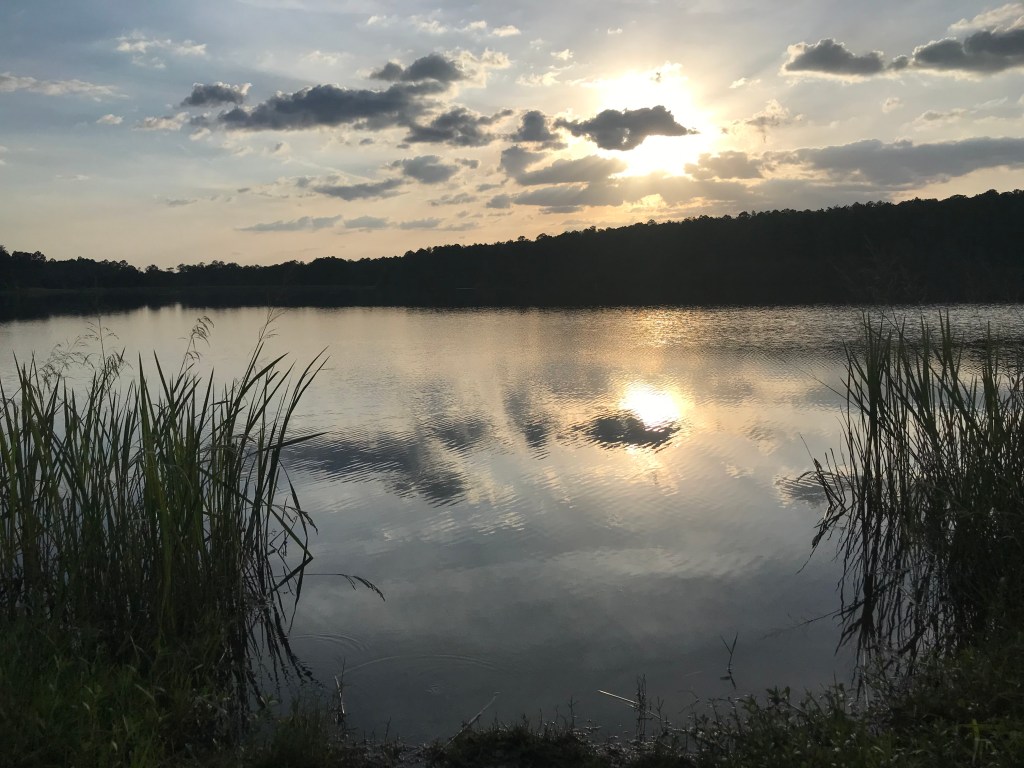
Bear Lake at Blackwater State Park in Florida. This was taken after survival.

Blog at WordPress.com.

Up ↑