Tips for working from home well

Over the past several years, one of the notable impacts of the COVID-19 Pandemic is how it has changed our work lives. Pre-pandemic, only 7% of the workforce (with jobs that allowed for it) worked from home full-time1. A more recent report from the Bureau of Labor Statistics reveals this number has jumped to 22.8% as of last August2.

If you’re among many people who, like me, enjoy the 5-second commute from your home to your… home, here are a few ways I’ve learned to make the home office a more productive and enjoyable place.

  1. It’s so helpful to have my office space in a different room than my bedroom. I know some people can’t afford this luxury, but it truly helps to compartmentalize my work life and home life. It’s not quite a “Severance” of work and home life. But it does help to leave some of the difficulties of work in the office (room).
  2. Unless you really need it, keep your phone out of the office space. If you leave it in your kitchen or living room, you’ll be continually less likely to go check it. It tends to take the form of a little devil on my shoulder if it stays on the desk, personally.
  3. Take frequent breaks. Go for a 5-minute walk, do some jumping jacks, or crank out some push-ups in your yard. For me, this is a challenge (it’s easy to get sucked into the code, like Neo from the Matrix). But when I do pause, I find I’m a tad bit less cranky at the end of the day (my wife thinks so too). Plus, you can take that time to call friends/family or even, dare I say, write a blog post. If you want more stories on the benefits of taking frequent breaks during work, NPR’s TED Radio Hour has a great Podcast called “Body Electric”.

Welp, time to get back to the black box that is Python. Do you have any ideas on what has worked best for you working from home?
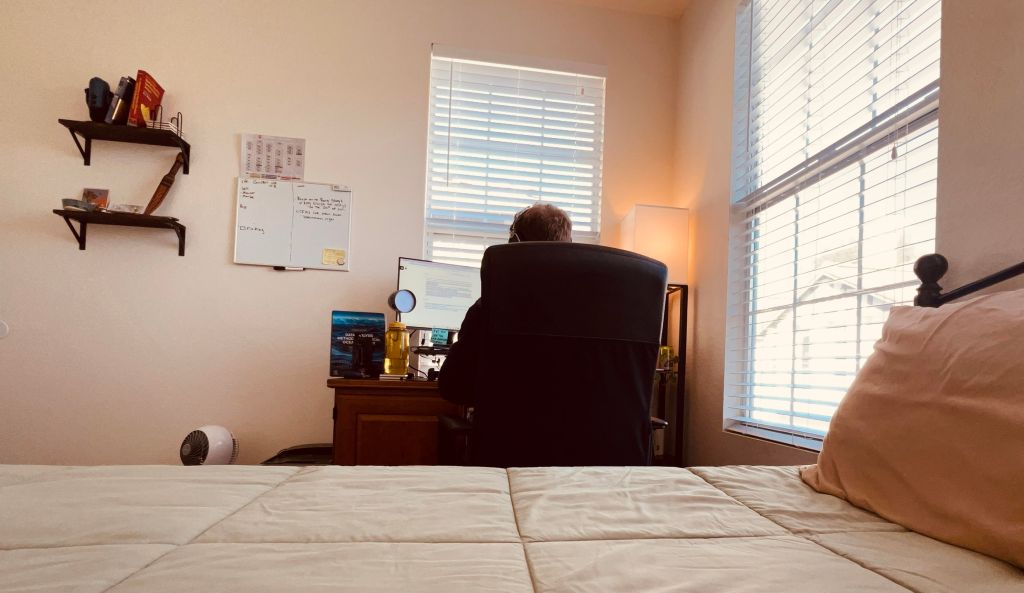
Working from our guest room today. If you zoom in you’ll see this post on the screen. Inception…

References

  1. https://www.pewresearch.org/short-reads/2023/03/30/about-a-third-of-us-workers-who-can-work-from-home-do-so-all-the-time/
  2. https://www.marketwatch.com/story/the-job-market-is-getting-tougher-for-workers-but-they-may-be-gaining-in-the-battle-over-remote-work-64fd9408

Not feeling in the right mood? Listen to a funny podcast!

Let’s paint the scene. You’re driving to a party at a friend’s house for Christmas. Thinking back on the day, you sigh. You couldn’t finish that dumb report technically due at the end of the day and stubbed your toe on the little bump in the entrance to your apartment this morning. Your toe still hurts.

To lighten the mood, you turn on a podcast from one of your favorite comedians, and pretty soon small huffs turn into chuckling. Before you know it, you’re all out laughing when you pull up to the party.

My friends laughing at the joke I told the other day. Kidding I have no idea who these people are. Photo by Jed Villejo on Unsplash.

Humor is a great way to cope with life’s stresses. In the book, The role of humor and the self1, people who respond to stressors humorously are “more likely to emerge from emotional duress and enjoy a restoration of positive mood states”. Other researchers found that study participants who recalled humorous times in their past had a higher pain tolerance threshold and a decrease in hormones associated with stress2. Ziv (1976)3 also saw adolescents who openly laughed at humorous stimuli scored higher on a creativity test than those who didn’t. Laughing will allow your mind to relax and explore those more “out there” thoughts which can lead to deeper and more engaging discussion with those around you.

Next time you’re in the car tapping anxiously on the steering wheel, pop on a podcast or remind yourself of the funny times in your past. You might just create another memory you can look back on and laugh.

  1. Lefcourt, H. M., & Davidson-Katz, K. (1991). The role of humor and the self. Handbook of social and clinical psychology: The health perspective, 41-56.
  2. Greenberg, M. J. (2024). Self-Guided Humorous Imagery Mitigates Pain and Anxiety: A Repeated Measures Pilot Study. Journal of Holistic Nursing42(2), 121-132.
  3. Ziv, A. (1976). Facilitating effects of humor on creativity. Journal of educational psychology68(3), 318.

Soak it in

That moment. When you get the best view in the house, just before the plunge. Your feet dangle into nothingness as meandering cotton candy-eating parkgoers begin to resemble mice in a maze.

And then Newton’s First Law of Motion sets in. Gravity takes hold. Suddenly you’re in a whir of sound, color, and adrenaline. You find it hard to catch your breath as you join the rows of screaming people locked into the experience with you. And then it’s all over.

You can probably relate those exhilarating times to other points in your life, like anticipation for events that go by with the snap of a finger. Hours upon hours of planning and thought. A flash. And then it’s over.

That was exactly how our wedding panned out. June 23, 2024. My lovely wife Braede and I have now had nearly a month and a half to debrief, and it has been so fun to recount little details of that day, like not having enough time for dessert, or posing on a chairlift that overlooked the Rocky Mountains.

What makes that time so special, though, is almost that we can’t go back and relive those hours surrounded by family and friends. Those times become immortalized through the stories we tell our kids years later. So if you’re gearing up for an event of your own, when it happens, take time to soak it in without getting bogged down by worries. Enjoy the moment. You may be able to add one more detail to your story.

Lessons from a Cormorant

If you take a summer stroll along the swaths of Agate Beach, Oregon, you’ll most likely get a glimpse of the diversity of bird life. You might see white gulls effortlessly split the wind in search of prey, Rock Sandpipers dart in and out of frothy swash, and the occasional dark slender neck of a Cormorant before it dives below the waves.

Photo by Kevin Grieve on Unsplash.

The species of Cormorant that call Oregon home can dive to depths of more than 200 ft in search of fish and small shellfish1. Once they surface, they’ll soar to a nearby tree branch at a selectively windy prominence and spread their wings to dry off. The Cormorant species have relatively less preen oil than most birds, which means their feathers soak in, rather than repel water2. The thought is that the insufficiency of preen oil allows the cormorant to maintain agility underwater while shedding buoyancy, allowing it to spend more time sub-surface in search of prey. What might be thought of as a hindrance to the Cormorant, enables it to be a much more efficient hunter.

There are at least two lessons to be learned from this particular bird. One, we all need rest. In a culture infatuated with the idea that “go go go” will lead to a satisfying and meaningful life, rest continually gets pushed off. Over the long term, you begin to realize you can’t truly live without a little downtime. Two, what might seem a weakness on the outside, can be a strength on the inside. If you are vulnerable with others you trust, for one example (among many), showing your scars, fears, and doubts, this can exemplify the inner strength of being comfortable enough around others and yourself to share who you really are.

What are lessons you can learn from the surrounding nature that you may have taken for granted in the past?

  1. https://www.allaboutbirds.org/guide/Brandts_Cormorant/overview
  2. https://www.kqed.org/perspectives/201103250735/cormorants

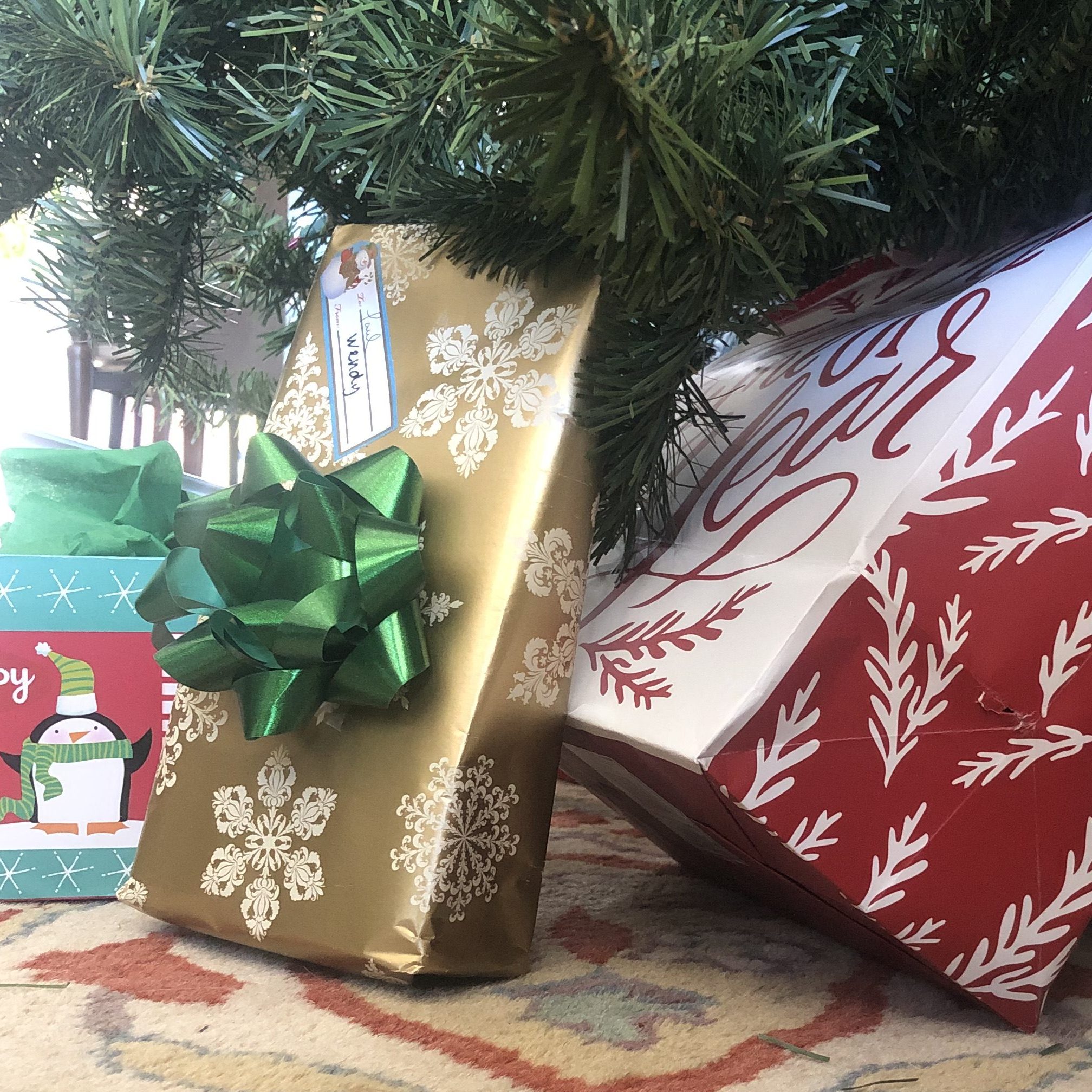
Gift giving

You unwrap the thin reindeer-covered box and notice the familiar brown of an Amazon package. After tearing the tape off the corners, you reveal a pair of socks bedecked in a pattern of mini Tabasco bottles. To boot, the size is L. You’re M. Your pal looks at you with expectation as you feign a smile through gritted teeth.

“Thanks, Jimbo,” you say, mustering what little resolve you have left in the tank. A flutter of fear flashes across his face and he knows he goofed.

Finding this scenario relatable? A 2021 survey conducted by The National Retail Federation1 indicates that the rate of gift returns shot up from 10.6% in 2020 to 16.6% in 2021. Seems that many Americans miss the mark on what they think others will like and what they truly enjoy. So, how can we give gifts that last the test of time? Below are a few tips on giving a great gift during the holidays:

  1. It might be a good idea to take time to reflect on the receiver’s personality type. A recent NPR report says that catering your gift to someone who is either into experiences, is practical, sentimental, cozy, or just an enigma to you can go a long way toward getting something that they will enjoy2.
  2. Consider giving an experience rather than a gift. Many times, givers tend to focus on the receiver’s immediate reaction, and more often than not, buy tangible items that can be used or consumed immediately, rather than a gift that takes longer to enjoy. However, a recent study has shown that doing this may be of greater benefit to the receiver in the long run3.
  3. Give a gift that has sentimental value! What experiences have you and the receiver had that you both cherish? Giving a gift that speaks to that relationship may sound risky, but will more than likely result in a better outcome than a gift that just caters to what you think the receiver’s preferences are4.

All this being said, simply showing someone that you care this season goes a long way. Just giving your time to give that call to a distant friend or relative may be the best gift of all.

Wishing you a wonderful Holiday season filled with fun, family, friends, and joy!

  1. https://nrf.com/media-center/press-releases/nrf-predicts-healthy-holiday-sales-consumers-navigate-economic
  2. https://www.npr.org/2022/12/14/1142750086/christmas-gift-giving-guide
  3. https://myscp.onlinelibrary.wiley.com/doi/full/10.1002/jcpy.1318
  4. https://www.sciencedirect.com/science/article/abs/pii/S105774081730044X

Blog at WordPress.com.

Up ↑