
Ok, I have to nerd out here.
As a coastal engineer, part of our research this December will involve putting out disposable drifters that capture surface currents over a submerged reef off Newport, Oregon (think little floats that ping their location up to SpaceX or something, where we’ll see the data in real-time). The goal is to understand how rip currents behave in the presence of a storm, and whether we can potentially model the behavior of these rips.
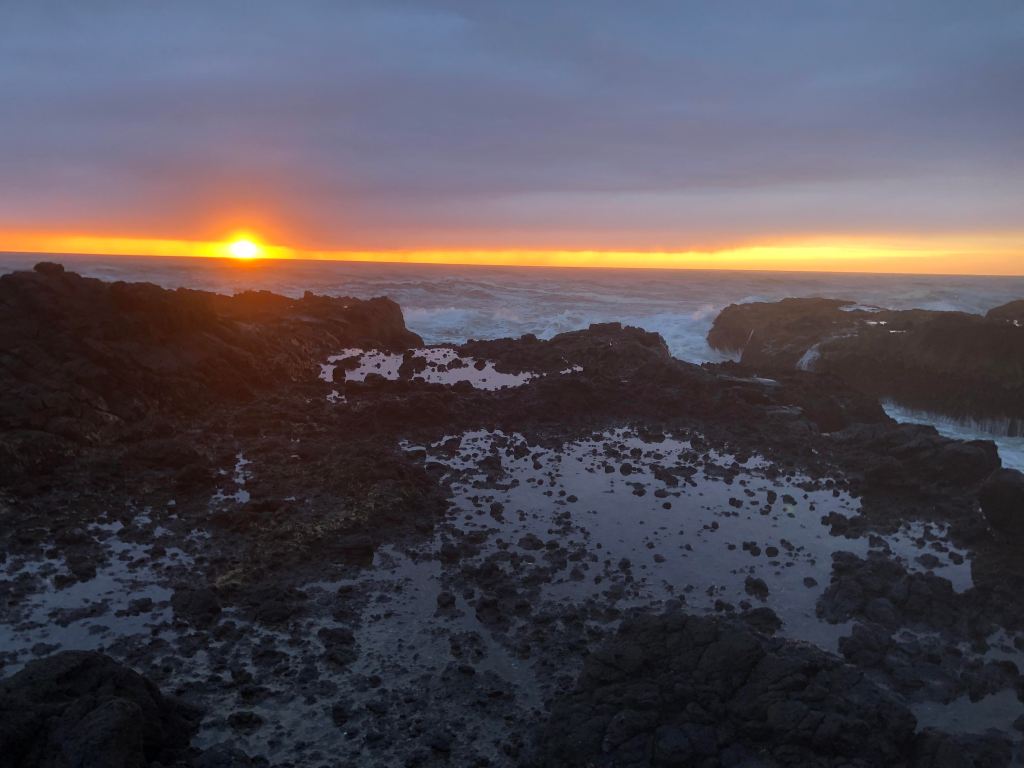
Scientists have tried to pin down exactly how rip currents behave for decades. It’s also been the bane of many a lifeguard’s existence since beach safety was first introduced. A 1941 article by Shephard et al. in the Journal of Geology stated that lifeguards referred to these things as “rip tides” or “sea pusses” (I don’t recommend you use the latter term). Since this time, our understanding of rips has increased substantially. A few facts for you:
- Rather early research describes rips are caused by an excess of water build up on the shore from waves, resulting in currents that move along the shore close to the beach. At varying times and locations, these currents meet and turn seaward to form outgoing rip currents (Mckenzee, 1958).
- More recent studies found that where rips form is directly linked to the variability of where waves break along the shoreline. This variability causes excess momentum in some areas and lessened momentum in others. Of course, energy will move from high to low. Thus, rips tend to form in certain areas and change in intensity and location, factors which scientists are hoping to predict more accurately in the future (Castelle et al., 2016).
- If you find yourself caught in a rip, follow the advice of several survivors, who say firstly, not to panic. Try not to fight the rip, but allow it to carry you as you try and swim parallel to the shoreline to escape the strongest current (Drozdzewski et al., 2012).
The coast is a fascinating place. It holds mysteries yet to be unlocked by the curious, excitement to the recreationist, and a sense of wonder to all who visit. The ocean is also a powerful force to be reckoned with, and knowing what it can do may just keep you from giving in to its watery g”rip”.
(For an example of the power of the ocean, see a previous post, “The Unmoving Coaster” from 2020).
- Castelle, B., Scott, T., Brander, R. W., & McCarroll, R. J. (2016). Rip current types, circulation and hazard. Earth-Science Reviews, 163, 1-21.
- Drozdzewski, D., Shaw, W., Dominey-Howes, D., Brander, R., Walton, T., Gero, A., … & Edwick, B. (2012). Surveying rip current survivors: preliminary insights into the experiences of being caught in rip currents. Natural Hazards and Earth System Sciences, 12(4), 1201-1211.
- McKenzie, P. (1958). Rip-current systems. The Journal of Geology, 66(2), 103-113.
- Shepard, F. P., Emery, K. O., & La Fond, E. C. (1941). Rip currents: a process of geological importance. The Journal of Geology, 49(4), 337-369.
 azureadventure.com
Leave a comment