Let ‘er rip

Ok, I have to nerd out here.

As a coastal engineer, part of our research this December will involve putting out disposable drifters that capture surface currents over a submerged reef off Newport, Oregon (think little floats that ping their location up to SpaceX or something, where we’ll see the data in real-time). The goal is to understand how rip currents behave in the presence of a storm, and whether we can potentially model the behavior of these rips.
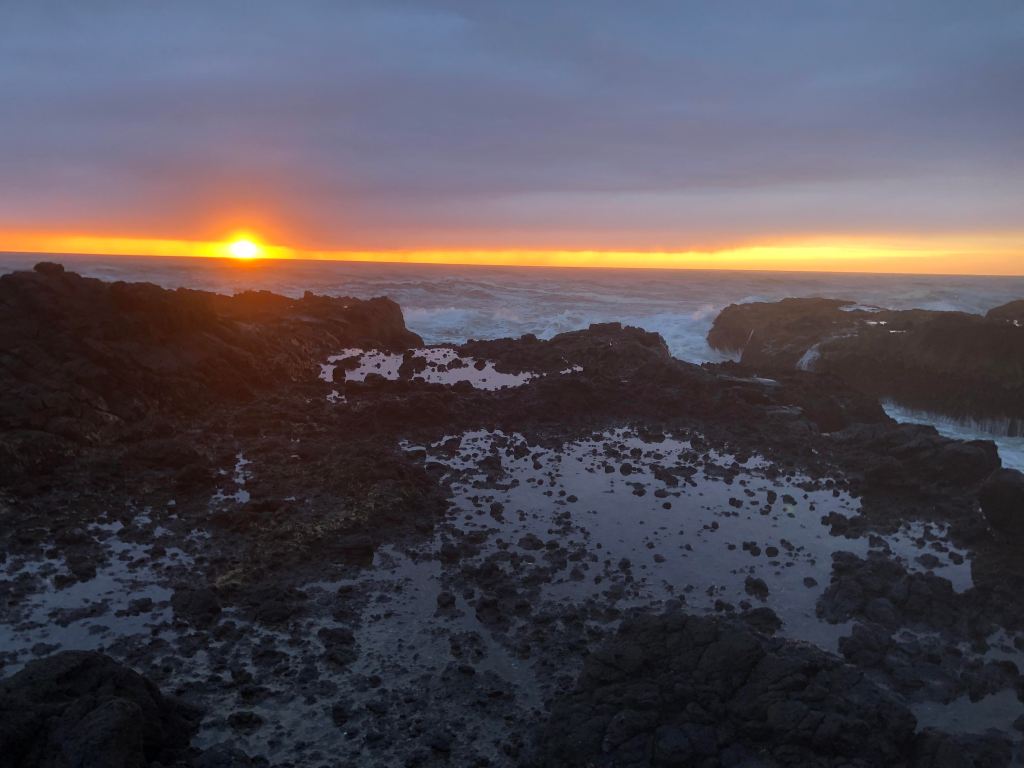
The Oregon coast in springtime

Scientists have tried to pin down exactly how rip currents behave for decades. It’s also been the bane of many a lifeguard’s existence since beach safety was first introduced. A 1941 article by Shephard et al. in the Journal of Geology stated that lifeguards referred to these things as “rip tides” or “sea pusses” (I don’t recommend you use the latter term). Since this time, our understanding of rips has increased substantially. A few facts for you:

  1. Rather early research describes rips are caused by an excess of water build up on the shore from waves, resulting in currents that move along the shore close to the beach. At varying times and locations, these currents meet and turn seaward to form outgoing rip currents (Mckenzee, 1958).
  2. More recent studies found that where rips form is directly linked to the variability of where waves break along the shoreline. This variability causes excess momentum in some areas and lessened momentum in others. Of course, energy will move from high to low. Thus, rips tend to form in certain areas and change in intensity and location, factors which scientists are hoping to predict more accurately in the future (Castelle et al., 2016).
  3. If you find yourself caught in a rip, follow the advice of several survivors, who say firstly, not to panic. Try not to fight the rip, but allow it to carry you as you try and swim parallel to the shoreline to escape the strongest current (Drozdzewski et al., 2012).

The coast is a fascinating place. It holds mysteries yet to be unlocked by the curious, excitement to the recreationist, and a sense of wonder to all who visit. The ocean is also a powerful force to be reckoned with, and knowing what it can do may just keep you from giving in to its watery g”rip”.

(For an example of the power of the ocean, see a previous post, “The Unmoving Coaster” from 2020).

  • Castelle, B., Scott, T., Brander, R. W., & McCarroll, R. J. (2016). Rip current types, circulation and hazard. Earth-Science Reviews, 163, 1-21.
  • Drozdzewski, D., Shaw, W., Dominey-Howes, D., Brander, R., Walton, T., Gero, A., … & Edwick, B. (2012). Surveying rip current survivors: preliminary insights into the experiences of being caught in rip currents. Natural Hazards and Earth System Sciences, 12(4), 1201-1211.
  • McKenzie, P. (1958). Rip-current systems. The Journal of Geology, 66(2), 103-113.
  • Shepard, F. P., Emery, K. O., & La Fond, E. C. (1941). Rip currents: a process of geological importance. The Journal of Geology, 49(4), 337-369.

On Love

I’ve recently begun the perilous, rewarding, nerve-wracking, riveting journey of seriously dating someone. She’s wonderful.

We’re compatible in so many ways.

We’re different in so many ways.

Sometimes I marvel at her ability to say exactly what I’m thinking, and yet, sometimes my thoughts resemble apples and hers oranges. Like stepping out of your car to an ocean when you thought you were going to be greeted with a vast mountainous expanse. But here’s the thing. There are places where the mountain meets the ocean and spectacular beauty lies there.

Every day is a journey in these uncharted waters, and I can’t wait to see what’s around the next bend.

Stay tuned.

A different energy

A legion of plastic cleats digs into turf. Pivoting. Planting. Stopping. Touching down for a moment, and then off, like a heated game of hot potato. All with one purpose. Come in contact with that elusive airborne sphere.

Moving up from the ground one can see the labored breathing of two teams vying for one shot at the goal on either side of their field of battle. Pennies vs. shirts. Every Saturday at 9 am. Here players leave their cultural and political differences at the gate and come together to share in what one can simply say as a heightened state of energy. There’s something to be said about the excitement surrounding the game.

Many of the members of the soccer club are Nigerian. They joke, laugh, and bring an emotion to the field that’s unlike any other (and man, most of them can wipe the floor with me). I just love being around those dudes.

When was the last time you felt wrapped up in a heightened state of energy?

*Thanks to Ben Smucker for help with descriptions!

Grease the groove

Lately, I’ve started to do morning stretches and cold showers. Just because.

I’ll wake up, follow the 5-minute stretch routine below, and pop into an ice cold shower (after a few deep breaths accompanied by a quick mental note asking myself why I’m doing this).

It’s honestly been healing. I feel more energized throughout the day, and subjecting myself to extreme temperatures in the morning gives a much needed shot of adrenaline so I can get to work or play feeling sharp and ready to go.

Have you challenged yourself to add some new flavors to your morning routine lately? If not, hop on the bandwagon and make it a New Year’s resolution. Some have even called it “greasing the groove”. So, I challenge you to switch it up and grease the groove. Sucks in the moment sometimes, but you’ll thank yourself in the end.

Fractals

Did you know that it’s technically impossible to capture a perfectly defined measurement of the perimeter of our coastlines?

As you know, coastlines across the world range from smooth beaches to rugged and rocky terrain. Imagine stopping time and taking an aerial picture of the coast nearest to you, with, say, a resolution of 5×5 km. Got the picture in your head? Whatever coastline you chose, the perimeter of that coastline will have jagged features with scales that range from kilometers to tiny micro-meters. How do you measure this?

Let’s start with, for example, a certain section of the Oregon coastline that we want to measure with a yardstick. Once we’re done (after probably months of work) let’s compare that measurement to a measurement of the same perimeter with the diameter of a penny (~19mm, and probably a lifetime or more of measuring). The total length of the measurements would be drastically different. The smaller your scale, the larger the total perimeter of your coastline… literally to infinity.

Benoit Mandelbrot, a famous mathematician, after discovering this phenomenon, said, “[The world’s] coastline length turns out to be an elusive notion that slips between the fingers of those who want to grasp it.”1

Our world is so incredibly complex.

  1. https://archive.org/details/fractalgeometryo00beno/page/25/mode/2up

Blog at WordPress.com.

Up ↑